
San Pedro de Atacama lies at about 23 degrees south of the equator. From there the southern half of the sky rises high, and the northern half dips lower than it does from Europe, North America or most of Asia. Polaris, the North Star, never shows at all; it stays below the horizon. In its place you get a sky full of objects that people living further north rarely or never see.
The Milky Way itself looks different too. Its brightest part, the crowded region towards the centre of the Milky Way galaxy, passes almost straight overhead in the southern winter. On a dark night it casts a faint glow you can notice on pale sand.
The two Magellanic Clouds
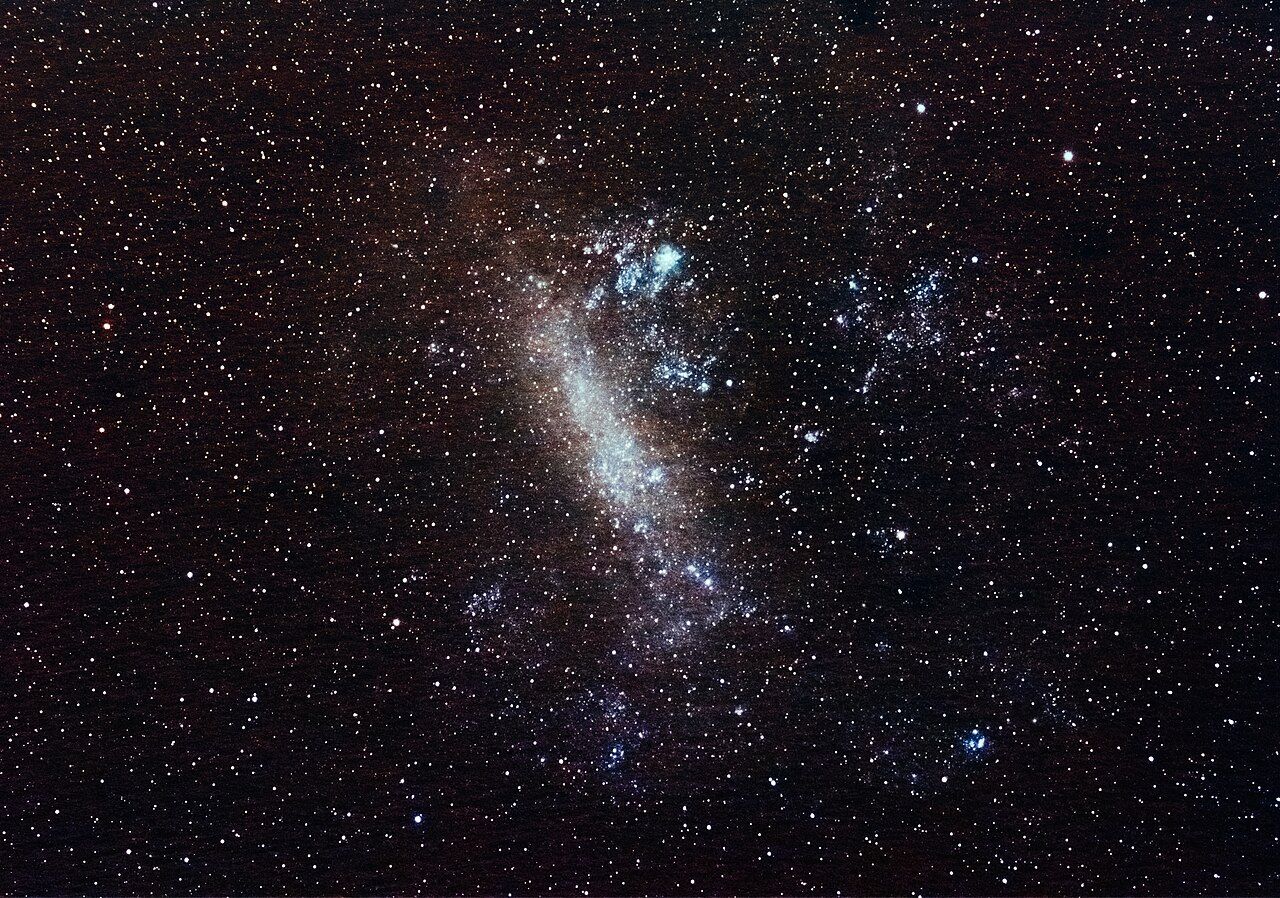
Look south on a moonless night and you see two hazy patches that could pass for torn pieces of the Milky Way. These are the Large and Small Magellanic Clouds, two small galaxies that orbit the Milky Way. The larger lies roughly 160,000 light-years away, the smaller roughly 200,000. Their light set out long before there were any humans to see it.
With bare eyes, the Large Cloud looks like a soft grey smudge a few times wider than the full Moon. Binoculars break it into knots, star clouds and glowing patches. One of those patches, the Tarantula Nebula, is a vast region of star birth bright enough to see without help on a good night.
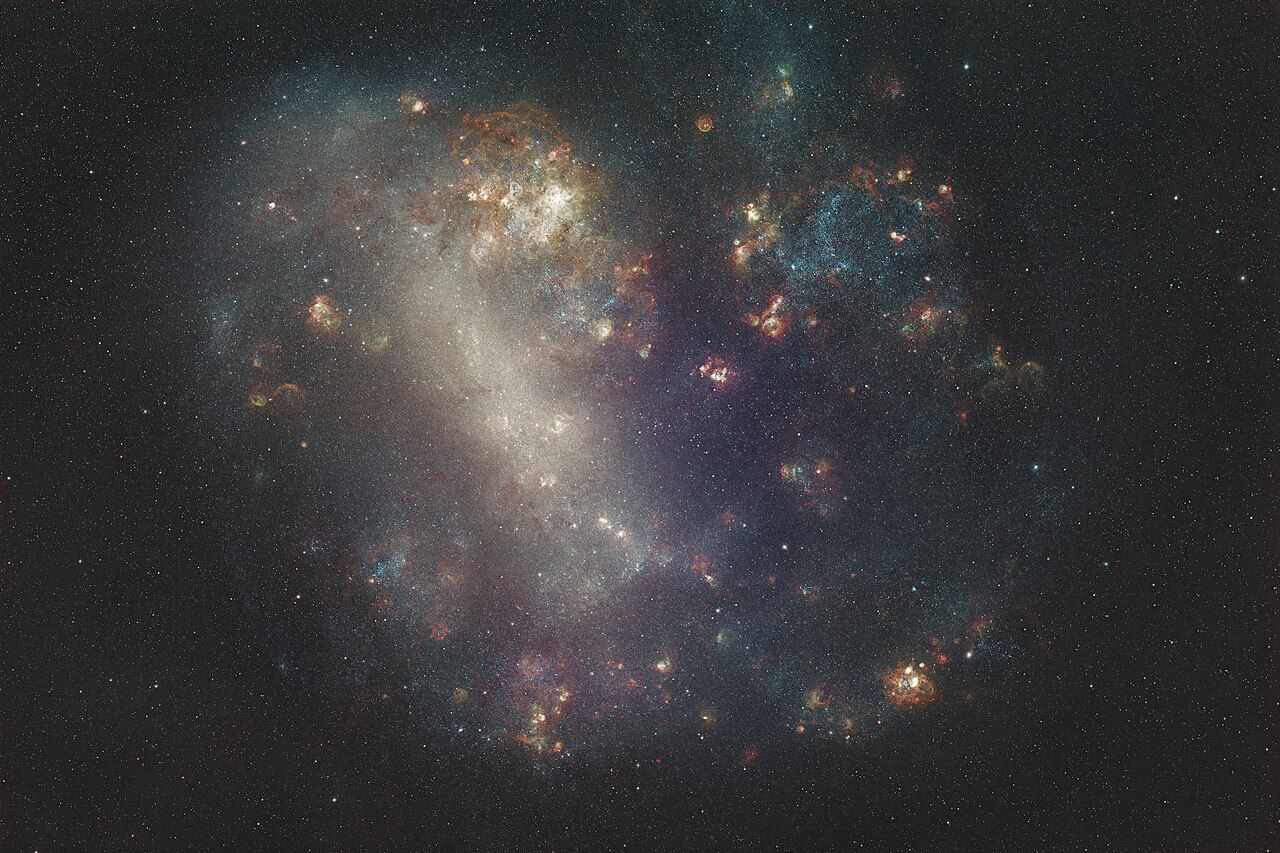
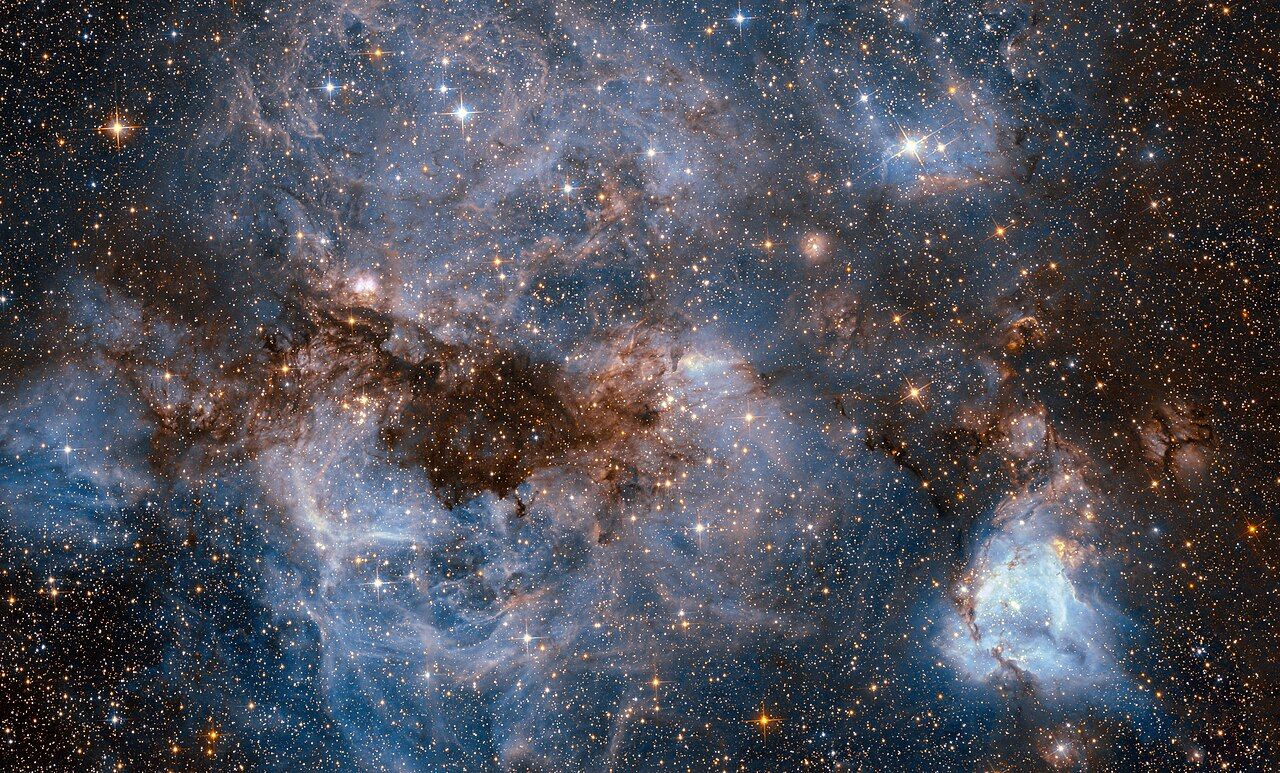
Space telescopes reveal even more. Images taken from orbit show storms of glowing gas and dark dust where new stars are forming inside the Large Cloud. You will not see that detail from the desert floor, but knowing it is there changes how you look at the faint smear above the horizon.
The clouds are circumpolar from the Atacama for much of the year, meaning they circle the south celestial pole and stay above the horizon or close to it. They ride highest on evenings in the southern spring and summer, from roughly October to January, and sink lower in winter.
The Southern Cross and its pointers
The Southern Cross, or Crux, is the smallest of the 88 official constellations, and first-time viewers often find it less grand than expected. Four bright stars form a slightly lopsided kite, with a fainter fifth star tucked in on one side. It appears on the flags of several southern countries, and once you know it you will see it everywhere.
Two brilliant stars nearby, Alpha and Beta Centauri, point towards it and help you tell the real cross from a larger and fainter look-alike known as the False Cross. Alpha Centauri is the closest bright star to the Sun, about 4.4 light-years away. Through binoculars, next to the cross, you can also find a cluster nicknamed the Jewel Box for its mix of blue and orange stars.
Look up next: The driest air, the darkest nights
Right beside the cross lies the Coalsack, a dark cloud of dust that blocks the light of the stars behind it. It looks like a hole in the Milky Way. On a really clear night in the Atacama it is easy to see, and it is the start of a different way of reading the sky.
Dark shapes in the Milky Way
European tradition joined bright stars into figures. Peoples of the Andes also read the dark patches between them. Along the Milky Way, which in Quechua is often called Mayu, the river, they saw animals made of shadow: a toad, a serpent, a partridge and, largest of all, a llama with two bright eyes formed by Alpha and Beta Centauri. The Coalsack is part of these shapes.
These dark constellations are easiest to trace in the southern winter, when the brightest part of the Milky Way runs high overhead. The stories tied to them belong to living cultures, and the Lickanantay people and the land guide gives some context for the region around San Pedro. Look for the shapes with an open mind rather than trying to fix exact outlines; they were never drawn in the same way by everyone.
Scorpius overhead and the centre of the galaxy
From the far north, Scorpius barely clears the horizon. From the Atacama in winter it climbs high overhead, a long curl of stars with the red giant Antares glowing at its heart. Its tail hooks down towards Sagittarius, where the Milky Way grows thickest and brightest. That region lies in the direction of the centre of the Milky Way galaxy, about 26,000 light-years away.
Several clusters and nebulae in this part of the sky show as faint patches to the bare eye and as rich fields through binoculars. Sweep slowly along the band of the Milky Way and stop wherever it looks knotted or lumpy; there is usually something there.
Familiar stars, upside down
Many patterns you know from home still appear, only flipped. Orion rises on summer evenings with his belt and sword turned the other way, so the sword seems to point up. The Moon looks inverted too, with its familiar features rotated. The stars of the northern sky that do show, such as parts of the Plough, sit low on the northern horizon at certain times of year.
Two showpiece star clusters make up for anything you miss. Omega Centauri, a ball of millions of stars, shows as a fuzzy star to the bare eye. Near the Small Magellanic Cloud sits 47 Tucanae, another globular cluster that looks like a misty star until binoculars turn it into a glowing ball.
A first night in the dark
- Pick a night near new moon. Even a half Moon hides the Magellanic Clouds and the dark constellations; see moon phases and the best nights.
- Bring a printed star chart for the right latitude and month, and a red light to read it.
- Use binoculars before any telescope. They show wide fields, which suit the clouds and the Milky Way.
- Dress for real cold and expect the temperature to keep dropping after midnight.
Most of all, let your eyes adapt. After half an hour away from white light, the southern sky stops looking strange and starts looking full.